JST CREST Project
Self-Mirroring Twins
Creating a Proactive Society through Behavior Transformation in Co-living with Self-Mirroring Twins
We investigate a new framework for human–AI coexistence that supports metacognition through interaction with “another self” and empowers people to think, choose, and act on their own initiative.
What are Self-Mirroring Twins?
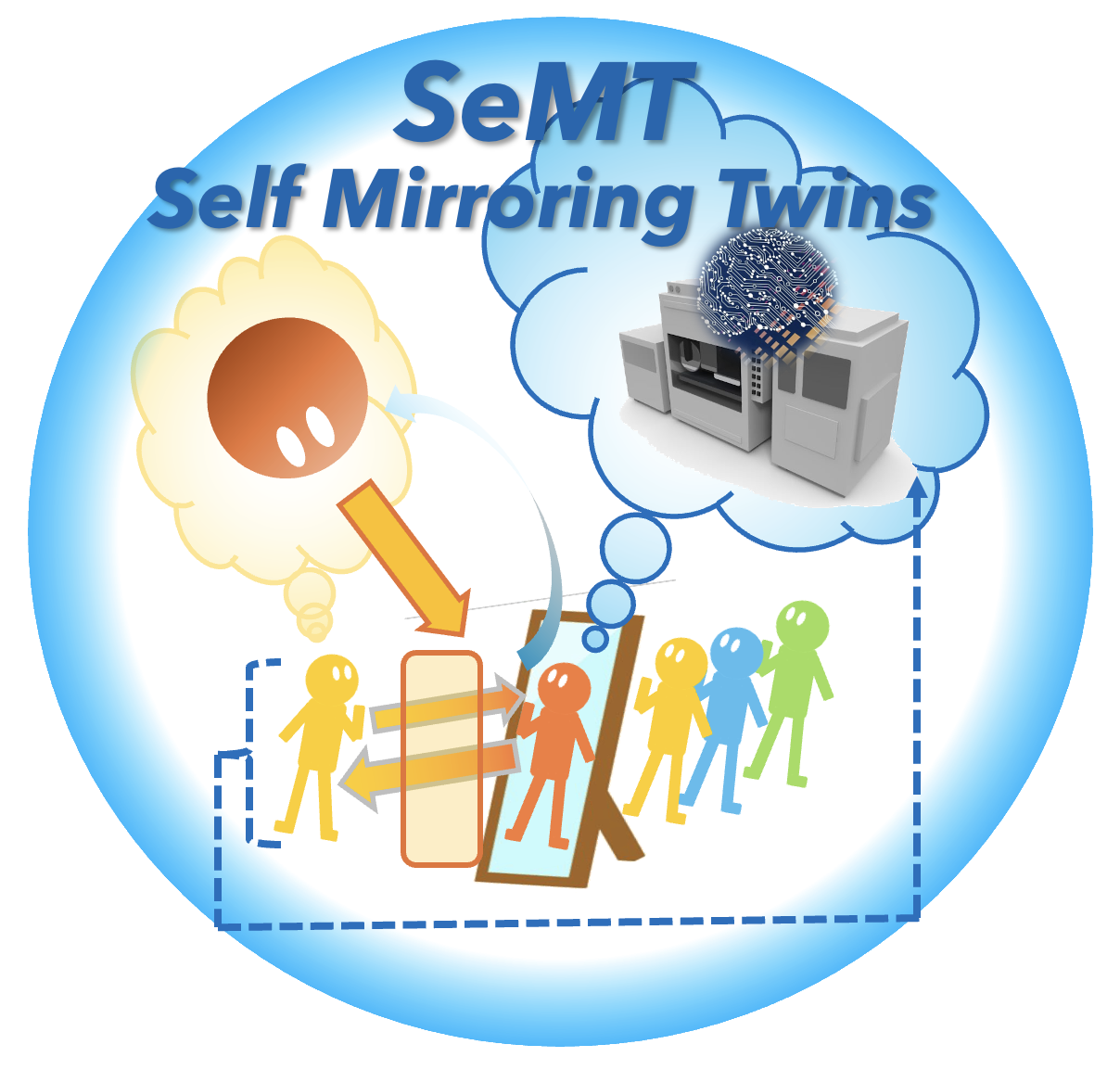
Self-Mirroring Twins (SeMT) are digital twins that reflect the user while continuously and gradually adjusting the boundary between self and other. Like a twin, SeMT helps people reflect on themselves, supports metacognition, and encourages self-directed behavior change.
Virtual SeMT
Virtual SeMT supports improvements in daily habits and social behavior through smartphones and XR environments. By reflecting not only an ideal self but also alternative possibilities, it fosters metacognition and behavior change.
Physical SeMT
Physical SeMT supports motor recovery and awareness of bodily conditions through assistive robots and prosthetic devices. Our goal is to enhance motor performance while preserving the user’s autonomy and avoiding excessive assistance.
Research Areas
The project advances five research areas, spanning foundational technologies for human–AI/robot coexistence and applications in daily life and physical support.
Research Area 1 | Platform Development for Virtual SeMT and Social Behavior Change
We develop SeMT platforms using VR, AR, and smartphones; build models of everyday behavior and behavior generation; and validate behavior change through social applications. Lead: Tetsunari Inamura
Research Area 2 | Applying SeMT to Physical Assistive Systems and Field Validation
Using rehabilitation robots and prosthetic devices, we investigate how body ownership, motivation, and self-efficacy relate to Physical SeMT behavior strategies and conduct field validation in care facilities. Lead: Shingo Shimoda
Research Area 3 | Adaptive and Empathetic SeMT Behavior Generation Engine
We develop computational models that reflect users’ internal states and behavior-change mechanisms that account for emotion, establishing SeMT behavior generation algorithms that enhance self-efficacy. Lead: Takato Horii
Research Area 4 | Evaluation Framework for Empathy toward SeMT and User Autonomy
Using brain activity and physiological signals, we estimate users’ internal states and the boundary between self and other, establishing objective and subjective evaluation methods for real-time adaptation of SeMT behavior. Lead: Tetsunari Inamura
Research Area 5 | Social Acceptance and Institutional Design for SeMT
We identify ethical issues and responses, evaluate social acceptance through public dialogue, propose technology-design guidelines, and support implementation through agile governance. Leads: Makoto Kureha and Minoru Asada
Team
Research Director:Tetsunari Inamura
Co-Principal Investigators: Shingo Shimoda, Takato Horii, Makoto Kureha, and Minoru Asada
Our interdisciplinary research team advances both fundamental research and social implementation in collaboration with academic institutions and industry partners.

Research Collaboration and Partnership Inquiries
We welcome inquiries from researchers, academic institutions, and companies regarding joint research, technology partnerships, and social implementation.