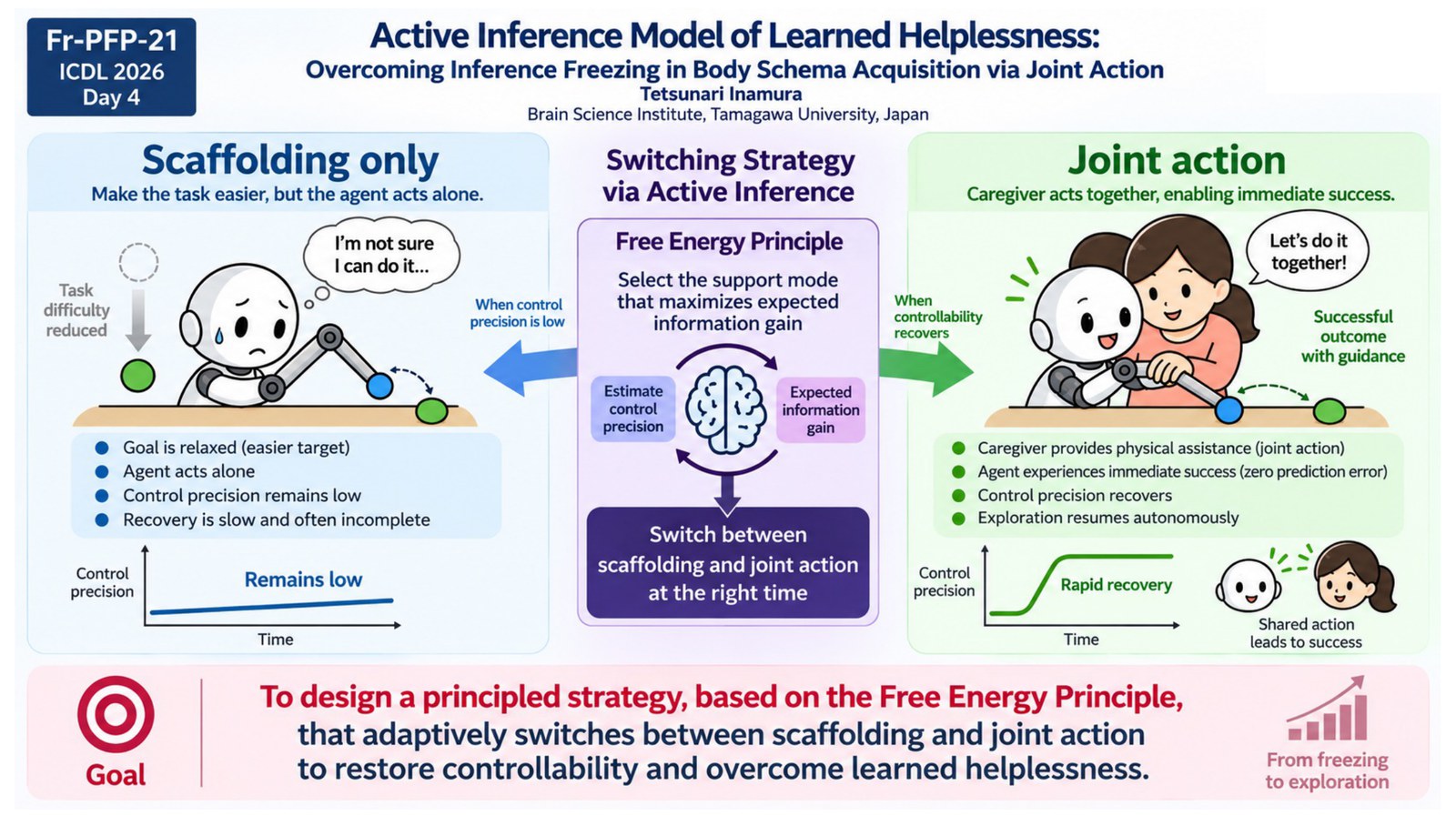
At IEEE ICDL 2026, held at Kyoto University from September 15 to 18, 2026, project leader Tetsunari Inamura presented "Active Inference Model of Learned Helplessness: Overcoming Inference Freezing in Body Schema Acquisition via Joint Action" (poster Fr-PFP-21).
Children explore the unknown on the strength of a conviction that their own actions can change the world. Under a persistently uncontrollable environment, that conviction breaks down and exploration stops altogether — learned helplessness. What makes it difficult is its irreversibility: recovery does not follow simply because the environment has become safe again.
This work derives that irreversibility from active inference under the Free Energy Principle. When control precision collapses, the expected information gain from acting vanishes and the agent stops acting. Because it stops acting, no new prediction errors arrive and precision updating halts. This self-closing loop produces a freeze that is practically irreversible on developmental timescales.
Simulations of body schema acquisition in a two-DOF robot arm further show that scaffolding — relaxing the task — is not sufficient to break the freeze. What is required is joint action: a caregiver moving together with the learner, supplying a forced zero-prediction-error experience that reboots control precision.
The finding reframes what a good supporter is. Not one who demonstrates the correct behavior, nor one who makes the task easier, but one who serves as a secure base that unlocks frozen inference.
For Self-Mirroring Twins, which seeks behavior change by making the self–other boundary adjustable, this study provides part of the theoretical foundation: a mathematical account of how another’s involvement reshapes a learner’s internal state. Discussions at the venue raised how much of their own intention a learner retains during joint action, and how the acceptance of another’s action should be positioned ethically — both of which we will carry into future extensions of the model.
This work was supported by JST CREST (JPMJCR2561) and JST Moonshot R&D (JPMJMS2294).
Full bibliographic details are listed on the Publications page.